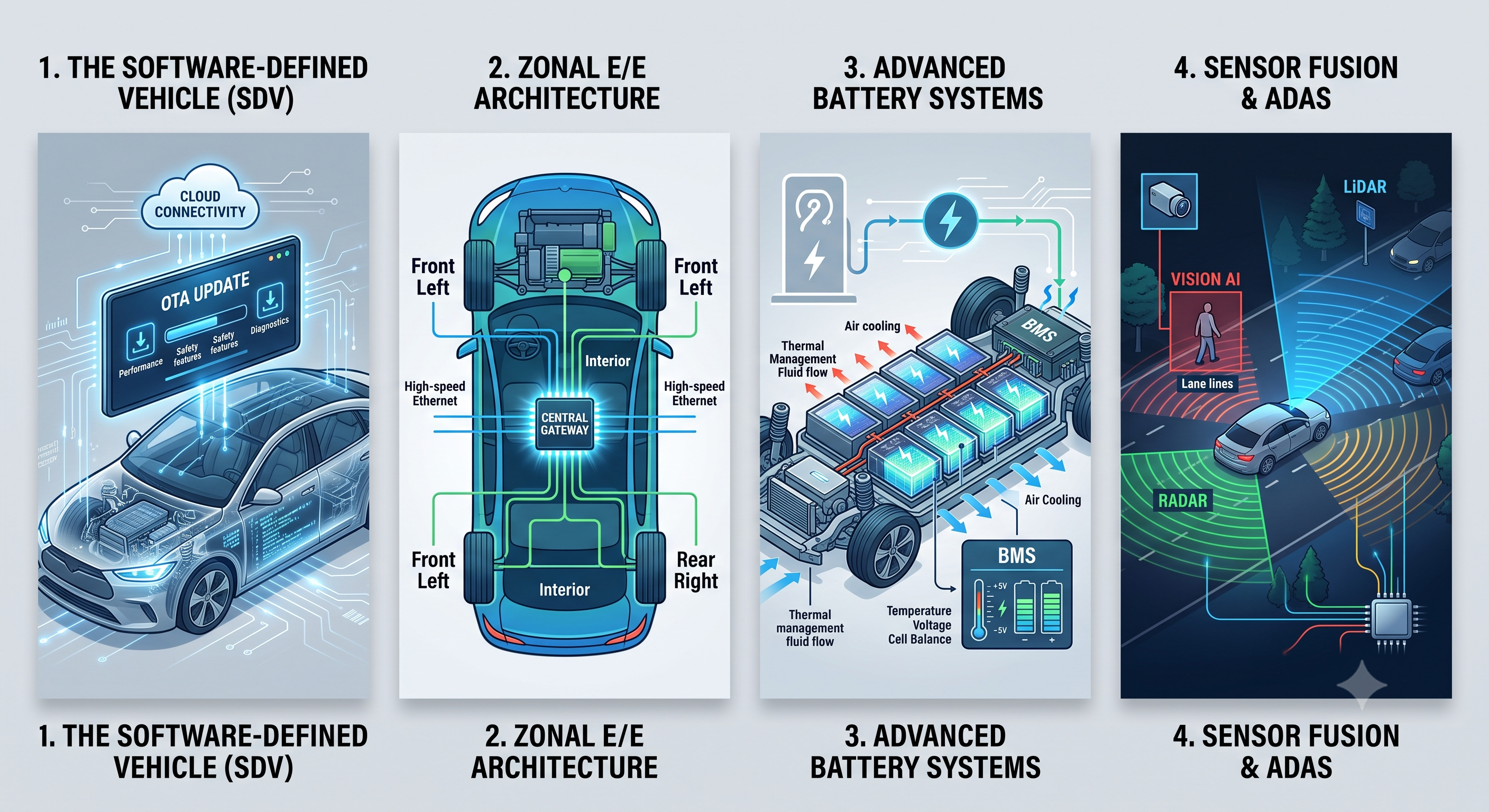
For a century, we judged a car by its horsepower, engine displacement, and the way it looked in the driveway. That era is ending. In 2026, a vehicle is increasingly defined by its computing power and its ability to improve itself through over-the-air (OTA) updates. The modern automobile is quietly transforming from a mechanical machine into a smartphone on wheels — and the change runs far deeper than the touchscreen on the dashboard.
This shift has a name: the Software-Defined Vehicle (SDV). Understanding it means looking at two linked revolutions happening under the sheet metal — one in software, and one in the electrical wiring that holds everything together.
What Exactly Is a Software-Defined Vehicle?
In a software-defined vehicle, the features, safety behaviour, and even performance characteristics are controlled primarily by cloud-connected software rather than fixed mechanical hardware. The hardware becomes a stable, capable platform; the software layer on top is what defines the experience — and that layer can be upgraded long after the car leaves the factory.
The practical result is that your car is no longer "finished" the day you buy it. Through OTA updates, a manufacturer can deliver new driver-assistance features, patch a safety issue overnight, improve battery management, or refine the way the car accelerates — all without a trip to the service centre.
The Death of the 100+ ECU Car
A traditional vehicle is a tangle of Electronic Control Units (ECUs) — dozens of small, separate computers, each dedicated to one job: the windows, the braking, the infotainment, the engine. A modern premium car could carry well over a hundred of them, all competing for space, power, and wiring.
SDVs collapse this complexity. Instead of a hundred isolated brains, functions are consolidated into a handful of powerful domain controllers or, increasingly, a zonal architecture built around high-performance processors such as Qualcomm Snapdragon Ride or NVIDIA DRIVE. Fewer, smarter computers do the work of many — which makes the whole system easier to update and far more capable.
Zonal E/E Architecture: The Backbone of Modern EVs
As electric vehicles pack in more infotainment screens, ADAS sensors, and high-voltage battery-management systems, the traditional wiring harness has become a serious problem. A conventional harness can weigh over 50 kg (110 lb) and stretch for kilometres through the chassis. In an EV, every extra kilogram of copper directly steals driving range.
Zonal E/E architecture is the engineering answer. Rather than routing wires from every single component all the way back to a central computer, components are grouped by their physical location in the car — a front-left zone, a rear-right zone, and so on. Each zone connects to a local zonal gateway, and those gateways talk to a central compute "brain" over high-speed automotive Ethernet.
The benefits are substantial:
- Less weight: dramatically shorter wiring runs cut harness weight, which improves EV range directly.
- Simpler manufacturing: zonal modules make automated factory assembly faster and more reliable.
- Better signal integrity: shorter, better-organised wiring reduces electromagnetic interference near high-voltage lines.
- Room to grow: a centralised compute core is far easier to update and expand than a hundred scattered ECUs.
The Monetisation Shift
The SDV model also changes how carmakers make money. Because features now live in software, manufacturers are moving toward feature subscriptions, real-time predictive diagnostics, and overnight safety patches. A car can gain a new capability — or have a defect quietly fixed — while it sits in your garage overnight.
This is powerful, but it is not without controversy. Buyers are rightly wary of paying monthly fees to unlock hardware that is already fitted to the car. The industry is still settling on where the line sits between a fair upgrade and a paywall on something you already own.
Why It Matters
The value of a vehicle is no longer locked in at the factory gates. A well-designed SDV can get safer, faster, and more capable over time through code — much like the phone in your pocket. For engineers, zonal architecture is the foundation that makes this possible; for drivers, it means the car you buy in 2026 should still feel modern years from now.
As the lines between automotive and consumer electronics continue to blur, the winners will be the manufacturers who treat the car as a living platform — and the buyers who understand that, increasingly, the most important part of a new car is the software they can't see.